










 ₹https://stores.adityavision.com/electronics-shops/sitapur/station-road/aditya-vision-in-station-road-sitapur--4MGQfQ/articles/how-to-choose-the-right-air-conditioner-for-your-h--567513d1-4361-4d39-8a88-0810595bbd75
Aditya Vision, Station Road, sitapur
Electronics Store in Station Road, Sitapur, Uttar Pradesh
Sanjrabad, Avas Vikas Colony, Nearby Railway Station, Station Road, sitapur, uttar pradesh - 261001
Request A Call Back
Aditya Vision Social Feeds in Station Road, sitapur
How to Choose the Right Air Conditioner for Your Home in Station Road, sitapur
Choosing an air conditioner is about much more than selecting a model that looks good or has a long list of features. The right AC needs to cool your room effectively, match the space available, suit your usage pattern and offer a balance between comfort and energy consumption. With options such as split AC, inverter AC, different capacities and a wide range of features, knowing how to choose an AC can make the buying decision much easier.
For homeowners and families in Station Road, sitapur, an AC can become an important part of everyday comfort, particularly when temperatures rise. However, buying an air conditioner without considering room size, usage, installation requirements and efficiency can result in poor cooling or unnecessary running costs.
This air conditioner buying guide covers the key factors to consider before making a purchase. From understanding AC capacity and AC tonnage to comparing inverter technology, energy efficiency, features and installation requirements, the aim is to help you make a practical and informed choice.
Why Choosing the Right AC Size Matters
One of the most important steps in learning how to choose AC is understanding why capacity matters.
An air conditioner needs to have enough cooling capacity for the room in which it will be installed. If the AC is undersized, it may need to operate for longer periods to achieve the desired temperature. If it is significantly oversized for the space, the cooling cycle and overall performance may not be ideal for your requirements.
This is why buying an AC simply because it has a higher capacity is not necessarily the best approach.
The right capacity depends on several factors, including:
Room size
Ceiling height
Number of occupants
Amount of direct sunlight
Number of windows and doors
Floor level
Local climate
Heat generated by appliances
How frequently the room is used
A room receiving substantial afternoon sunlight, for example, may have different cooling requirements from a shaded room of the same size.
The goal should be to find an AC capacity that matches the actual cooling requirement of your space.
Aditya Vision includes air conditioners among its home-appliance offerings, giving consumers access to a broad consumer-durables portfolio from multiple brands.
How to Select AC Capacity for Your Room
Understanding AC tonnage is another important part of the buying process.
In simple terms, AC tonnage refers to the cooling capacity of an air conditioner. It does not refer to the physical weight of the appliance. Common residential AC capacities include options around 1 ton, 1.5 ton and 2 ton, although the appropriate choice depends on the room and other conditions.
If you are searching for what ton AC is suitable for a room, avoid relying on room size alone. Room dimensions provide a starting point, but other factors can influence the actual cooling requirement.
For example, a compact bedroom with limited sunlight may have different requirements from a similarly sized room with large windows exposed to direct sunlight.
Before choosing a capacity, consider the following:
Measure the Room
Calculate the approximate floor area by multiplying the length by the width. Also consider ceiling height because a room with a significantly higher ceiling contains more air volume.
Consider Sunlight
Rooms exposed to strong sunlight can gain more heat during the day. This can influence the cooling capacity required.
Think About Occupancy
People generate heat, so a room regularly occupied by several people may require different cooling performance from a room normally used by one or two people.
Consider Appliances
Computers, televisions, lighting and other appliances can contribute to heat inside a room.
Ask About Professional Sizing
If you are uncertain, professional guidance can help determine the appropriate capacity for your space.
The right AC for bedroom requirements may also differ from those of a living room because bedrooms are often smaller and used during specific periods of the day. Instead of choosing based on assumptions, evaluate each room individually.
Inverter vs Non-Inverter AC
One of the most common questions when buying an air conditioner is whether to choose an inverter AC or a non-inverter model.
The key difference relates to how the compressor operates.
An inverter AC can vary compressor speed according to the cooling requirement. Instead of repeatedly switching the compressor fully on and off in the same way as a conventional fixed-speed system, an inverter system can adjust operation to maintain the desired temperature.
This can provide advantages in comfort and efficiency, depending on usage conditions and the specific model.
A conventional non-inverter AC generally operates with a fixed compressor speed and cycles the compressor on and off to maintain the temperature.
When comparing the two, consider your usage pattern.
An inverter AC may be particularly worth considering if you use the air conditioner for extended periods and want more consistent temperature management. However, the overall value depends on the purchase price, usage frequency, room conditions, electricity consumption and the efficiency of the specific model.
Do not choose solely because a model carries the word "inverter". Compare the specifications, efficiency information, features and suitability for your room.
What to Know About Energy Efficiency
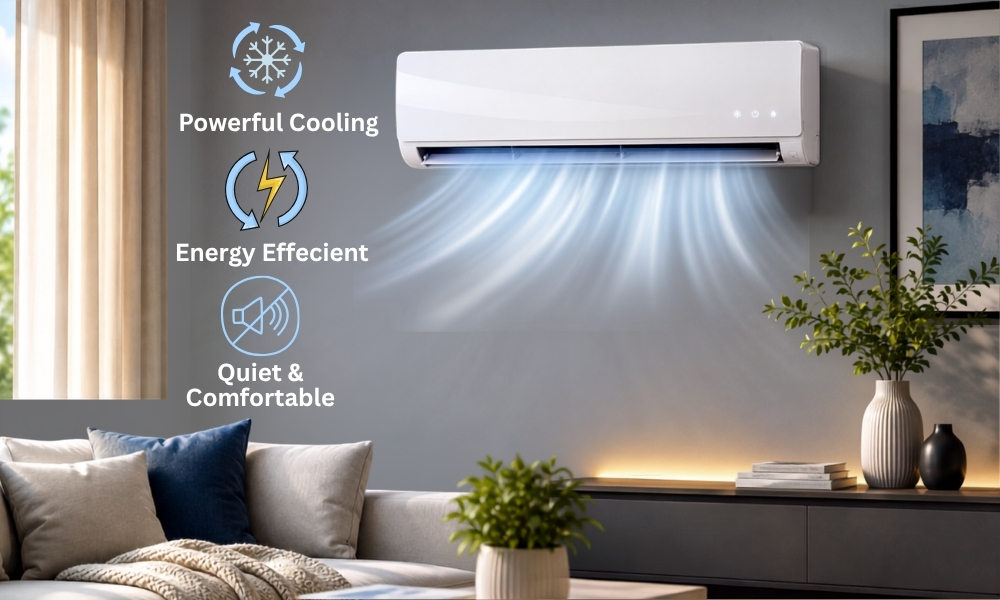
Energy consumption is an important consideration when choosing an energy efficient AC.
An air conditioner can provide excellent cooling, but frequent or prolonged use can contribute significantly to household electricity consumption. This makes efficiency an important factor when comparing models.
When evaluating energy efficiency, look at the applicable energy-rating information and compare models within the same capacity category. A higher efficiency rating can indicate better energy performance under the relevant testing conditions.
However, actual electricity consumption can vary depending on several factors.
These include:
Room size
Set temperature
Outdoor temperature
Duration of use
Insulation
Number of occupants
AC capacity
Maintenance
Frequency of door opening
Usage mode
For everyday comfort, avoid setting the temperature unnecessarily low. A moderate temperature setting can help balance comfort and energy use.
You should also keep filters clean and ensure that the outdoor unit has adequate airflow. Poor maintenance can affect cooling performance and efficiency.
Therefore, when considering how to select an air conditioner for home, energy efficiency should be evaluated alongside capacity and usage rather than treated as a separate decision.
Features to Consider Before Buying an AC
Modern air conditioners offer much more than basic cooling. Depending on the model, you may find features designed to improve convenience, comfort, control and maintenance.
However, more features do not automatically mean a better AC.
Start by identifying the features that are relevant to your everyday use.
Temperature and Operating Modes
Different cooling modes can be useful for different situations. Look at the available operating modes and understand what they are designed to do.
Remote and Smart Controls
Some ACs provide convenient remote-control functions, while selected models may support smart connectivity. These features can be useful if you want greater control over the appliance.
Airflow Control
Adjustable airflow can help direct cool air where it is needed. Check the available swing and airflow settings when comparing models.
Filtration
Depending on the model, ACs may include different types of filters or air-cleaning features. If indoor air quality is important to you, understand exactly what the feature does rather than relying only on marketing terminology.
Noise Levels
For a bedroom, study or work area, noise can be an important consideration. Check the manufacturer's stated noise information when available.
Convenience Features
Timers, sleep-related settings, display controls and other functions can make everyday use easier.
The ideal best AC for home is therefore not necessarily the model with the greatest number of features. It is the one that provides the right combination of cooling, efficiency, convenience and suitability for your space.
Choosing an AC for Different Room Sizes
There is no universal answer to which AC capacity is suitable for every room. Room dimensions should be used as a starting point, followed by consideration of sunlight, occupancy, insulation and other heat sources.
For Smaller Bedrooms
A smaller bedroom may require a lower-capacity AC than a large living area. Consider the room's dimensions, sunlight exposure and typical occupancy before selecting the capacity.
For Medium-Sized Bedrooms
A medium-sized bedroom may require a higher cooling capacity depending on the room's orientation, number of occupants and heat gain.
For Larger Living Rooms
Living rooms often have more occupants, larger windows and greater overall space. These factors can increase cooling requirements.
For Top-Floor Rooms
Top-floor rooms can experience greater heat gain, particularly when the roof receives direct sunlight. Insulation and ceiling height should therefore be considered along with floor area.
Instead of asking only what ton AC is suitable for a room, think about the complete cooling environment. This approach can help you avoid choosing an AC that is either insufficient or unnecessarily powerful.
Installation and Maintenance Considerations
Choosing the right AC does not end when you select the model.
Installation can have a significant impact on how effectively the system performs. The indoor and outdoor units need to be positioned appropriately, and installation should follow the manufacturer's requirements.
Before purchasing, understand what installation services are included and whether any additional requirements may apply.
The location of the outdoor unit also matters. It should have adequate ventilation and should not be unnecessarily obstructed.
After installation, regular maintenance is essential.
Clean filters periodically according to the manufacturer's recommendations. Dirty filters can restrict airflow and may affect cooling performance. Keep the outdoor unit free from unnecessary obstruction and arrange professional servicing when required.
It is also useful to check whether the retailer or manufacturer provides after-sales support in your area.
For consumers in Station Road, sitapur, considering installation and service availability before buying can make the overall ownership experience more convenient.
Common AC Buying Mistakes
Knowing what not to do can be just as useful as knowing how to choose an AC.
Choosing Capacity Based Only on Price
The cheapest AC may not be the most suitable if its capacity does not match your room.
Buying a Higher Capacity Than Necessary
A bigger capacity is not automatically better. Choose according to your room's cooling requirement.
Ignoring Energy Efficiency
If you expect to use the AC regularly, energy efficiency can make an important difference over the ownership period.
Focusing Only on Features
Do not pay extra for functions you are unlikely to use. Prioritise cooling performance, capacity, efficiency and reliability.
Forgetting Installation
A suitable AC still needs proper installation. Understand the installation process before purchasing.
Neglecting Maintenance
Even a high-quality air conditioner needs appropriate cleaning and servicing to maintain performance.
Not Considering Room Conditions
Sunlight, insulation, windows and occupancy can all influence cooling requirements. Do not make the decision based solely on floor area.
Final AC Buying Checklist
Before purchasing your air conditioner, review the following AC buying checklist:
Measure the room where the AC will be installed.
Consider ceiling height and room layout.
Assess direct sunlight and heat exposure.
Consider the number of people normally using the room.
Determine the appropriate AC capacity.
Compare suitable AC tonnage options.
Decide whether an inverter AC suits your usage pattern.
Compare energy-efficiency information.
Check useful features rather than simply counting them.
Consider noise levels if buying an AC for bedroom use.
Review airflow and filtration features where relevant.
Check available controls and connectivity.
Understand installation requirements.
Check maintenance and after-sales support.
Compare the overall value before making your final decision.
Choose the Right AC for Your Home With Confidence
Knowing how to choose the right AC for your room becomes much easier when you look beyond the brand name or price tag. The right decision starts with understanding your room, selecting an appropriate AC capacity, comparing efficiency and deciding which features genuinely fit your lifestyle.
For families in Station Road, sitapur, the climate and everyday usage pattern make choosing the right cooling solution especially important. A thoughtfully selected air conditioner can provide comfortable cooling while helping you avoid the common problems associated with incorrect sizing or unsuitable features.
Aditya Vision's consumer-durables portfolio includes air conditioners and air coolers alongside refrigerators, washing machines and other home appliances. The company states that it offers products across more than 100 Indian and international brands, giving customers a broad range of consumer electronics and appliances to consider.
Whether you are purchasing your first AC, replacing an older unit or upgrading your home's cooling system, take the time to compare capacity, efficiency, technology, features and installation requirements.
If you are exploring the best AC for home in Station Road, sitapur, use this guide to understand your requirements before visiting Aditya Vision. A well-informed decision can help you choose an air conditioner that is better suited to your room, your routine and your long-term comfort.